The Central Coast Astronomical Society, in partnership with the San Luis Obispo Botanical Garden, is offering a free hands-on astronomy program for high school students in grades 9-12.
This small-group series is designed for students who are curious about astronomy and want to learn how to actually observe the night sky. No previous astronomy or telescope experience is required.
Only 12 students will be selected for the program so that everyone has time to work directly with astronomers, binoculars, and telescopes.
What Students Will Learn
The series is built around three progressive workshops:
Workshop 1: Learn the Night Sky with Star Charts & Binoculars
Tuesday, January 19, 2027 from 6:00-8:00pm
Students will learn how to orient themselves under the night sky, identify bright stars and constellations, understand basic sky motion and magnitude, use star charts, and begin star hopping.
Each student will also receive a pair of 7×50 binoculars to use throughout the program and keep afterward. Students will learn how to focus them properly, hold them steady, scan the sky, and use them with a star chart to locate objects.
Workshop 2: How Telescopes & Binoculars Work
Tuesday, January 26, 2027 from 6:00-8:00pm
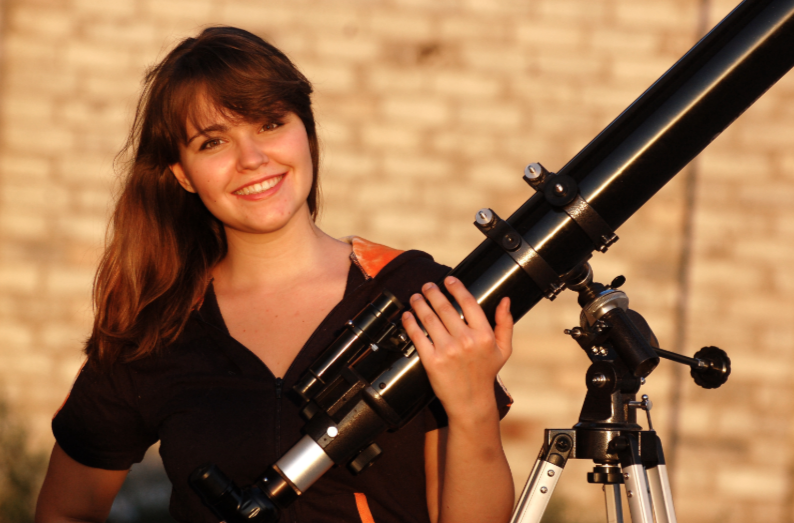
Students will work directly with several types of telescopes, including refractors, Schmidt-Cassegrain telescopes, and Dobsonian reflectors.
They will learn about aperture, focal length, eyepieces, magnification, field of view, focusing, and finders, and will rotate through telescope stations where they can practice aiming, focusing, changing eyepieces, and comparing views.
Workshop 3: Observe the Night Sky with Astronomers
Tuesday, February 2, 2027 from 6:00-8:00pm
Students will begin learning how astronomers actually observe different types of objects, including planets, double stars, open and globular clusters, nebulae, and galaxies.
They will compare views through binoculars and telescopes, record what they observe, and learn why what we see through a telescope can look very different from astrophotographs.
Field Trip: Dark-Sky Observing Night
Saturday, February 6, 2027 at Santa Margarita Lake (weather permitting)
The final observing night gives students the chance to put everything they have learned together under darker skies.
Students will bring their binoculars and work with CCAS astronomers and telescopes to:
- identify constellations
- locate star clusters and Milky Way regions
- practice finding targets with binoculars
- help point and operate telescopes
- compare different eyepieces and instruments
- observe fainter nebulae, galaxies, and clusters that are difficult to see from town
Weather Backup Plan for Workshops
Because this is an observational astronomy program, clear skies matter. If any of the first three Tuesday workshops are clouded out, that session will move to the following Wednesday evening. Applicants must plan to keep both the scheduled Tuesday and the following Wednesday available. The Santa Margarita Lake observing night is also weather dependent.
What Makes This Program Different
This is a hands-on astronomy program, not a lecture series. Students will use binoculars and telescopes themselves, learn how to find objects in the night sky, ask questions, compare what they see, and make their own observations.
The goal is to help students feel comfortable using real astronomy equipment and give them the skills and confidence to keep exploring the night sky on their own.
By the end of the series, students should be able to:
- navigate the night sky more confidently
- use binoculars independently
- understand the major types of amateur telescopes
- use basic telescope equipment with guidance
- locate and observe a variety of celestial objects
- understand how amateur astronomers explore the sky
Who Should Apply?
This program is for high school students who are genuinely interested in astronomy, space, science, or learning how to observe the night sky.
You do not need to:
- own a telescope
- have used a telescope before
- have taken an astronomy class
- already know the constellations
- have previous STEM program experience
Curiosity, interest, and willingness to participate are much more important than previous experience.
Attendance Commitment
Because space is very limited and each workshop builds on the previous one, students MUST attend the full series. Please review all scheduled dates, including the weather-backup evenings, before applying. The program is completely free for accepted high school students. Telescopes, observing equipment, star charts, and other program materials will be provided.
Application Process
Applications open: September 24, 2026 at 9:00 AM
Click Link to Apply Now
Application deadline: October 26, 2026
Applications are not first-come, first-served. All applications received by the deadline will be reviewed together. Students will be selected based on eligibility, availability, interest in the program, and overall program fit. A waitlist will also be created. Applicants can expect to hear from the Botanical Garden in early November.
Students Should Complete Their Own Application
We want to hear directly from the students who are interested in participating. The application includes questions about what interests you about astronomy, what you would like to learn, and what you have wondered about in science or space. Parents and guardians are welcome to help with contact information and scheduling, but the student should complete the written portions of the application themselves.
Location
The first three workshops will take place at the San Luis Obispo Botanical Garden. The dark-sky observing night will take place at Santa Margarita Lake. Additional details about arrival times, parking, what to bring, and family supervision will be provided to accepted students before the program begins.
Presented by
The Youth Observational Astronomy Workshop Series is presented by the Central Coast Astronomical Society in partnership with the San Luis Obispo Botanical Garden. CCAS astronomers will provide the astronomy instruction, telescopes, observing guidance, and hands-on mentoring throughout the series. If you are curious about the night sky and would like to learn how astronomers actually explore it, we encourage you to apply!