Join the Central Coast Astronomical Society for a special evening with Dr. Bob Field, Research Scholar in Earth and Planetary Science. Dr. Field has spent years exploring the story of cosmic evolution, from the formation of the elements inside stars to the emergence of planets, life, intelligence, and increasingly complex systems.
In this talk, he will turn the focus toward one of the biggest questions in science: How did life begin on Earth?
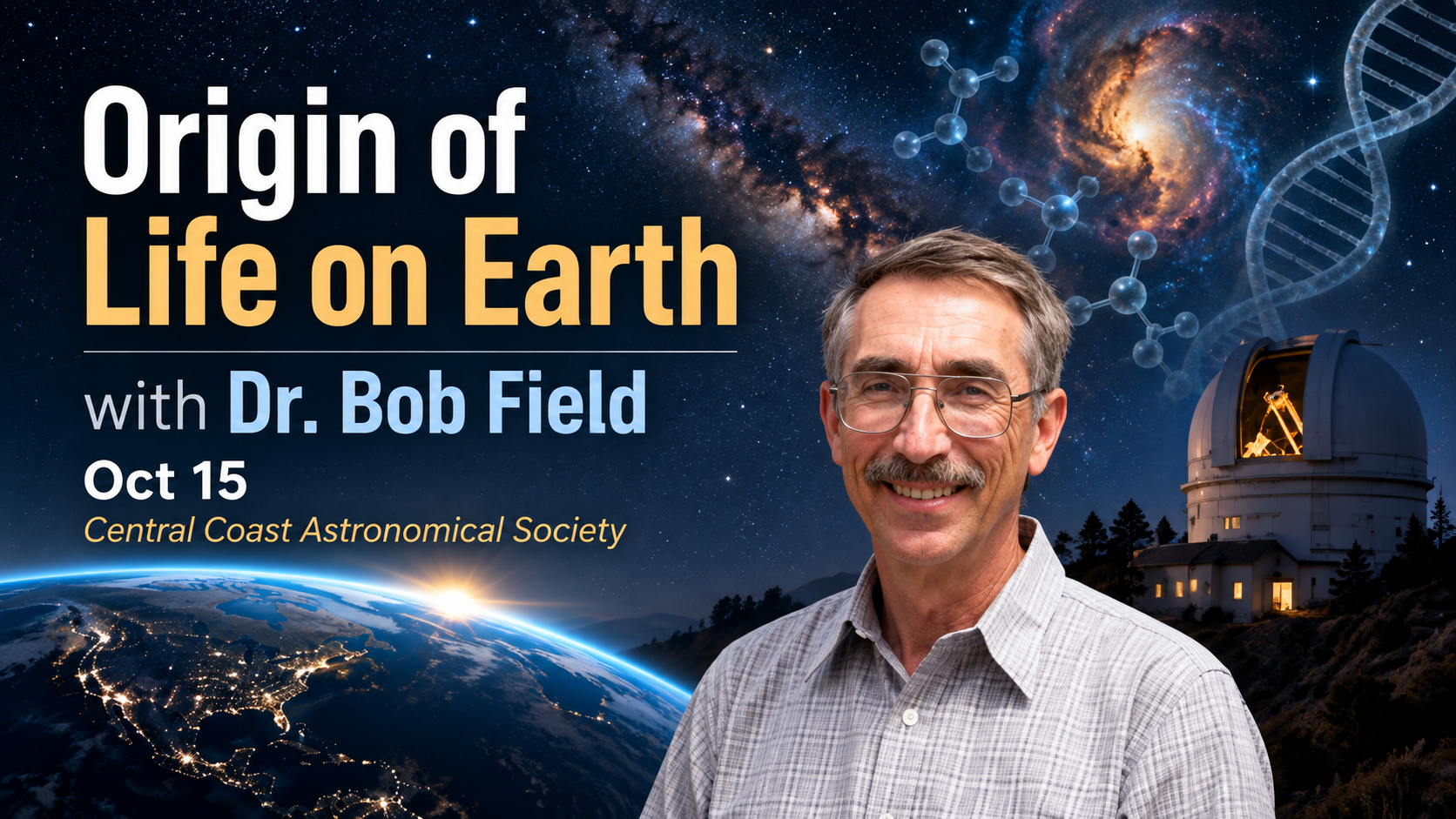
Dr. Field will explore what scientists understand about the transition from chemistry to biology, the conditions that made early life possible, and how the evolution of complexity on Earth fits into the much larger story of cosmic evolution. He will also discuss how modern computational modeling and artificial intelligence are giving researchers new ways to investigate the emergence of life and intelligence, both on Earth and potentially elsewhere in the universe.
Thursday, October 15th at 7pm
at 1515 Fredericks, San Luis Obispo
Directions
Please follow the “ASTRONOMY” signs when turning into the main driveway, stay to the right and head down to the lower parking lot to park. Use the stairs (or elevator) to get to the 2nd floor and find us in the “Wesley Room” at the top of the stairs. We have Astronomy banners posted at the front entrance to the building. (If it’s your first visit, please plan on arriving early in case you need extra time to find us, it’s a big building complex.)
What to Expect
We start right at 7:00PM with our welcome and club announcements, and move right into our talk (so please be prompt!). Our guest speakers usually talk for about an hour, including allowing time for questions from the audience. We do take a cookie break after the Q&A and then have a 20 min “mingle & meet the astronomers” time that is fun and enjoyable for all. We always love connecting with new folks interested in space, science, and astronomy. We wrap up by 9:00PM. This event is fun, free, family-friendly, and open to the public. CCAS hosts just four featured speaker evenings each year, so we hope you’ll join us!
Who is the talk for?
This talk is open to anyone interested in astronomy, planetary science, the origins of life, or the question of how complexity arose in our universe. All ages, free and open to the public. The video below is a quick intro to how to start thinking about the big question: “Where did life on Earth come from?” Video is courtesy of NASA.
About the Speaker
Dr. Bob Field is a Research Scholar in Earth and Planetary Science at California Polytechnic State University. He earned his BS in Physics from Case Western Reserve University and his MS and PhD in Physics from the University of Illinois.
Dr. Bob Field is an experimental solid state physicist who helped design space-based laser systems and optical components for 20 years. He created natural science programs in local state parks and our natural history museum for ten years. He has been supervising Cal Poly student projects in astrophysics, cosmology, Earth science, and biology for 26 years. He and his associates at Berkeley and UCSB are using AI to explore the scientific literature on the origin of life, its metabolic diversification, and its coevolution with Earth.
Dr. Field’s talk explores the origin of life on Earth at a time when our planet bore little resemblance to the pale blue dot we know today. Early Earth would have been inhospitable to most modern life, yet those very conditions may have provided an ideal environment for our earliest ancestors to emerge and diversify.
Searching for Life in a Rusty Green Sea on a Pale Orange Dot
Imagine a planet completely alien to our own. It spins rapidly and has a thick, orange, oxygen-free sky, lit only by a faint, young star. Below, a global ocean of rusty green water churns under massive tides, turning pitch black just a meter beneath the surface. Asteroids scream through the atmosphere, vaporizing the top 100 meters of the sea surface while millions of volcanic eruptions constantly pierce the ocean floor. Unseen are billions of iron-rich alkaline hydrothermal vents formed by serpentinization that quietly expel hydrogen gas into the sea.
This hostile world isn’t a distant exoplanet orbiting a faraway star. It is Earth, 4.2 billion years ago. We will journey into the chaotic Hadean Eon to explore the ultimate paradox of planetary science: how rocket fuel (hydrogen gas) venting from the seafloor sparked the prebiotic metabolism that gave birth to our Last Universal Common Ancestor (LUCA) in the pitch-black depths of an ancient ocean.
Earth’s extreme history suggests that our search for life in the cosmos requires us to consider an environment that looks entirely extraterrestrial: a dense carbon dioxide atmosphere, an iron-rich global ocean, extreme tidal forces, and relentless asteroid impacts. In this talk, we will explore a very plausible hypothesis about the cradle and origin of life and how cosmic, chemical, and biological processes built our oldest ancestors and led straight to us.